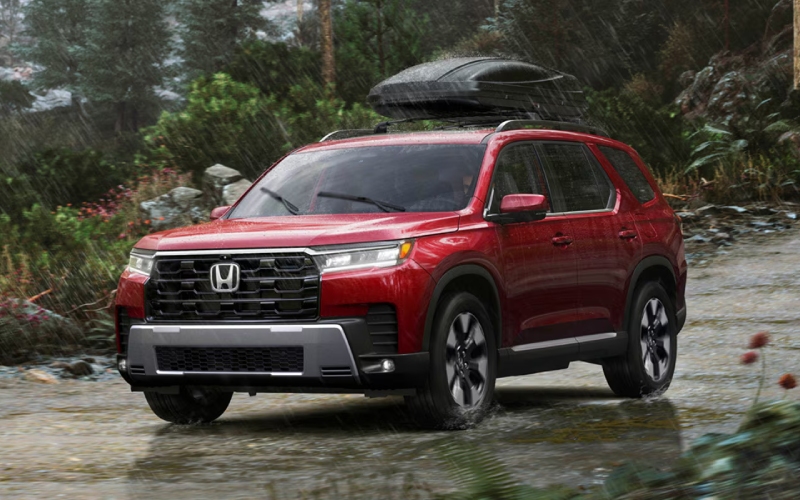
McGrath Honda Of St. Charles - Which three-row SUV is the smarter AWD pick for Elgin, IL families — the 2026 Honda Pilot or the 2026 Hyundai Palisade?
When Elgin, IL shoppers compare the 2026 Honda Pilot and the 2026 Hyundai Palisade, one question leads the list: which SUV delivers more confident all-weather traction and everyday control without making the tech feel complicated? That’s the point of this guide. We will unpack how each model approaches traction, how their drive modes work in the real world, and how cabin functionality supports family life from early-morning school runs to weekend getaways.
Start with fundamentals. Pilot’s available i-VTM4® torque-vectoring all-wheel drive can actively route power side to side across the rear axle, helping the SUV rotate more naturally into a corner and pull itself through low-grip patches with calm precision. On snowy neighborhood streets or wet leaves near trailheads, that behavior makes steering inputs feel intuitive. Hyundai’s HTRAC® system is a strong performer too, delivering helpful front-to-rear torque distribution and offering Mud, Sand, and Snow terrain modes. On XRT PRO, Palisade also adds an electronic rear limited-slip differential for improved traction. Both systems raise confidence, but the Honda’s rear-axle torque-vectoring chemistry creates a uniquely composed feel when grip changes mid-corner or across staggered surfaces.
Drive modes matter just as much. Pilot offers up to seven modes: Normal, ECON, Sport, Snow, Trail, Sand, and Tow on upper trims. These presets alter throttle response, transmission mapping, and torque splits to match conditions. On unplowed side roads, Snow mode dials in gentler inputs and stability. Off pavement, Trail and Sand modes better manage wheelspin and traction control thresholds. Palisade’s terrain modes and Tow Mode also adapt vehicle behavior effectively; the Hyundai calibration emphasizes predictable responses when conditions are loose, while Honda’s tuning leans into precision and steering feel, especially with i-VTM4® engaged.
Cabin tech plays a quiet but crucial role in confidence. Pilot’s Multiview camera system with TrailWatch™ on TrailSport and above offers ground-level camera views near the tires, making it easier to place a wheel on a rutted two-track or avoid a hidden curb. Palisade counters with an available Surround View Monitor and even a forward ground view on XRT PRO, which is welcome in tight trailheads and crowded lots. Inside, Honda’s Google built-in integrates Maps, Assistant, and key apps natively, cutting the friction out of voice navigation and everyday commands. Hyundai’s connectivity suite includes Bluelink® services and Alexa Built-in; it’s powerful, though Pilot’s Google integration can feel more plug-and-play for mixed-device households.
Daily usability might be the most telling factor. Families juggling car seats and changing cargo needs will appreciate Pilot’s stowable 2nd-row, fold-flat center seat on EX-L and above. Switch from eight to seven passengers without hunting for storage space at home. CabinTalk® lets the driver reach the third row through the audio system, which can reduce the back-and-forth on busy days. Palisade earns points for available relaxation seats in the first and second rows, a power-folding third row, and an available 14-speaker Bose® system that brings concert-hall clarity to road trips. The Hyundai cabin leans into lounge-like luxury; the Honda layout excels at fast reconfiguration and clear communication.
Towing and trail hardware also influence the decision. When properly equipped, both SUVs can tow up to 5,000 pounds in ICE configurations. Pilot TrailSport adds off-road-tuned suspension, steel skid plates, all-terrain tires, and integrated recovery points, amplifying confidence on two-tracks after a rain. Palisade XRT PRO brings extra ground clearance, all-terrain tires, Downhill Brake Control, and an exposed recovery hook look that signals purpose. For families who mix city life with occasional trail exploring, both deliver. For those who want steering precision on variable surfaces and off-pavement visualization baked in, Pilot’s i-VTM4® plus TrailWatch™ pairing is tough to beat.
Ownership experience is more than a spec sheet. Honda Sensing® comes standard across the Pilot lineup, including Collision Mitigation Braking System™ (CMBS™), Road Departure Mitigation, Adaptive Cruise Control with Low-Speed Follow, and Lane Keeping Assist. Hyundai SmartSense equips Palisade with a wide array of driver-assist features as well, plus unique tech such as a built-in dual-camera Dash Cam and an Advanced Rear Occupant Alert. Both SUVs prioritize safety. The Pilot’s ACE™ body structure and consistent Honda Sensing® standardization make it easy to choose any trim and feel fully supported.
If you are deciding between these two for traction confidence around Elgin’s mixed urban-suburban routes, the Pilot’s available i-VTM4® torque-vectoring behavior and TrailWatch™ camera views tilt the scale. If hybrid availability is the key, the Palisade’s new HEV adds a strong alternative. For most families, Pilot’s blend of predictable control, intuitive tech, and flexible seating functions makes everyday driving simpler while keeping weekend plans wide open.
- AWD traction focus: i-VTM4® torque vectoring in Pilot versus HTRAC® with added eLSD on Palisade XRT PRO — both capable, with Honda emphasizing cornering precision on mixed-grip roads.
- Usability highlights: Pilot’s stowable 2nd-row center seat and CabinTalk® streamline family flow; Palisade’s relaxation seating and power third row lean luxurious.
- Trail tech and towing: TrailWatch™ camera views and TrailSport hardware boost Pilot’s trail confidence; Palisade XRT PRO counters with added clearance and Downhill Brake Control.
- Define your priorities: Traction precision, hybrid availability, or cabin flexibility will point you toward the right fit.
- Match trims to routines: Consider which features will be used weekly, not just annually.
- Test drive in real conditions: Bring the family, car seats, and gear to validate space, visibility, and comfort.
We welcome your questions and encourage back-to-back test drives to feel the nuances firsthand. McGrath Honda Of St. Charles offers knowledgeable guidance and a transparent walkthrough of trims and features, serving Batavia, Elgin, and Naperville with a focus on everyday usability and long-term confidence.
Frequently Asked Questions:
Does the 2026 Honda Pilot’s i-VTM4 all-wheel drive feel different from the Palisade’s HTRAC in daily driving?
Yes. Pilot’s i-VTM4® can send power side to side across the rear axle, which helps the SUV turn in more naturally and track predictably through mixed-grip corners. HTRAC® is very capable, and XRT PRO’s eLSD helps, but the Honda system emphasizes cornering precision that many drivers notice right away.
Which is easier to use day to day — the Pilot’s Google built-in or the Palisade’s connectivity features?
Pilot’s Google built-in streamlines navigation and voice commands without extra pairing steps, which is great for households that use Google services. Palisade’s Bluelink® and Alexa Built-in deliver robust capability, though some drivers find the Honda approach more immediately familiar.
How do the third rows compare for family utility?
Both offer usable space, but Pilot’s one-touch 2nd-row access and the stowable 2nd-row, fold-flat center seat on EX-L and above make it easier to switch between passenger and cargo priorities during busy weeks.
Which model is better for light off-road exploring?
Both can handle light trails. Pilot TrailSport adds off-road-tuned suspension, skid plate protection, and TrailWatch™ camera views for wheel placement. Palisade XRT PRO brings extra ground clearance, all-terrain tires, and Downhill Brake Control. Your choice hinges on whether you value camera-based wheel placement and torque vectoring (Pilot) or extra clearance and DBC (Palisade).