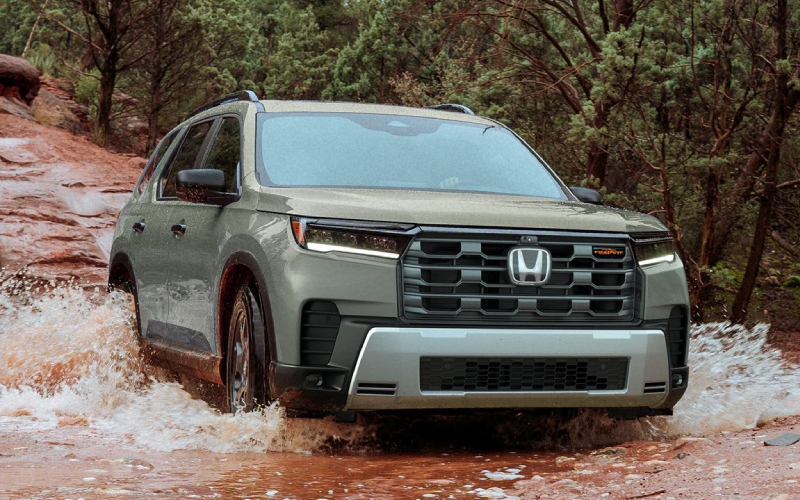
McGrath Honda Of St. Charles - Which three-row SUV has the smarter all-weather traction for Schaumburg, IL — 2026 Honda Pilot or 2026 Ford Explorer?
When shoppers start comparing three-row SUVs for Midwest weather, the central question quickly becomes: which one delivers more confident traction without complicating everyday life? Around Schaumburg, IL—where a sunny morning can give way to slushy intersections by evening—that answer matters. Let’s examine how the Pilot’s i-VTM4® AWD and the Explorer’s Intelligent 4WD approach traction, stability, and control, and how each system supports the kind of mixed driving suburban families do every week.
Honda’s approach starts with confidence you can feel. The Pilot pairs a standard 285-hp V-6 with available i-VTM4® AWD, a torque-vectoring system that can actively apportion power across the rear wheels. When one side of a slick neighborhood street has packed snow and the other is damp asphalt, that fine-grained torque delivery helps the tire with grip do more of the work, which you sense as a calm, predictable launch. Add up to seven available drive modes—Normal, ECON, Sport, Snow, Trail, Sand, and Tow—and you can tailor throttle mapping, shift logic, and traction control to match the surface. The result: quicker confidence in changing conditions, with less fiddling.
How the Explorer’s 4WD Compares
Ford’s Explorer offers rear-wheel drive with available Intelligent 4WD and selectable drive modes. It is a stable, familiar layout that distributes power effectively and, in the Tremor® trim, adds off-road tuned suspension, a Torsen® limited-slip rear axle, and underbody protection for added durability away from pavement. That is a compelling package for rough-road travel, and many drivers will appreciate the straightforward operation of Ford’s Terrain Management system when moving from rain-slicked roads to gravel lots. Where the Pilot’s setup distinguishes itself is in that torque-vectoring behavior—i-VTM4® can proactively send power to the wheel that can use it instead of relying as much on brake-based interventions.
Honda also leans into visibility and control aids that make slippery or off-camber surfaces easier to read. On TrailSport and higher trims, Pilot’s Multiview camera system with TrailWatch™ shows front, side, and surround views on a 12.3-inch color touch-screen. Threading between snow banks after a plow passes or easing into an angled driveway becomes less guesswork and more glide path. Combine that with Hill Descent Control and the Pilot’s composed suspension tuning, and you get a vehicle that maintains its poise from suburban cul-de-sacs to rutted access roads along the Des Plaines River.
Everyday Comfort That Helps in Bad Weather
Bad weather is tiring, and that is where cabin features matter. The Pilot’s tri-zone climate and available heated outboard 2nd-row seats keep everyone comfortable, while the Head-Up Display (on upper trims) keeps key info in your line of sight. CabinTalk® lets you get the crew’s attention without raising your voice—helpful when asking who needs boots after pulling into the driveway. Google built-in streamlines voice commands for navigation detours when an incident snarls I-90, and the available Bose premium sound system provides welcome calm on long, gray commutes. Explorer answers with an available B&O® Sound System by Bang & Olufsen®, strong digital instrumentation, and BlueCruise available on select trims for hands-free highway driving. Those are real strengths, yet for winter-weary families the Pilot’s visibility tools and tactile control advantages tend to stand out.
Towing remains a wash—both SUVs can be equipped to tow up to 5,000 pounds—which is plenty for small campers or a two-place snowmobile trailer. If your weekend plans include unpaved parking lots at sled hills or parks, the Pilot TrailSport’s steel skid plates and raised ride height add peace of mind. Explorer Tremor® counters with its own added clearance and underbody protection, so capability is genuine on both sides. The difference is that Pilot’s system tries to feel intuitive whether you are parking in a tight alley or easing across a patched, slippery intersection—it is less about headline numbers and more about making winter feel ordinary again.
How We Guide Shoppers
At McGrath Honda Of St. Charles, we walk drivers through a route that mirrors typical Schaumburg and northwest suburban roads—low-speed turns, a quick merge, a bumpy side street—so you can feel traction and steering composure in real time. If winter traction is your priority, we encourage a back-to-back drive and a demo of TrailWatch™ on a TrailSport or higher trim. Our team is also serving Naperville, Aurora, and Schaumburg and can tailor your test drive questions to specific commutes, school runs, or weekend destinations.
Frequently Asked Questions:
Does the Pilot’s i-VTM4® feel different from traditional AWD in daily driving?
Yes. Because i-VTM4® can send power side-to-side across the rear axle, the Pilot often feels more composed when one side of the vehicle has better grip. You notice calmer launches, fewer traction-control flashes, and steadier arcs through damp turns.
Is the Explorer’s Intelligent 4WD enough for Midwest winters?
It can be. With the right tires, Intelligent 4WD provides solid traction. If you regularly encounter mixed-friction surfaces or steep, slick driveways, Pilot’s torque-vectoring i-VTM4® may feel more secure and require fewer course corrections.
Which trims best match all-weather goals?
For Pilot, consider EX-L with available AWD for balanced value, Touring for added tech, or TrailSport for enhanced clearance and underbody protection. For Explorer, look at trims with Intelligent 4WD and the features you value, such as heated seats and the 360-Degree Camera.
Do I need to use specific drive modes for snow or slush?
Selecting Snow mode on Pilot or the appropriate terrain mode on Explorer helps fine-tune throttle and traction behavior. The systems will still work in Normal, but the calibrated modes reduce effort and improve feel in challenging conditions.
How about visibility in tight, snowy lots?
Pilot’s available Multiview camera system with TrailWatch™ provides multiple angles at low speed, which helps you line up cleanly between snowbanks. Explorer’s 360-Degree Camera provides helpful overhead perspective on certain trims as well.